Southeast Missouri sites preserve Indigenous history, culture
FOX23 News at 9 p.m.
CAPE GIRARDEAU, Mo. (KBSI) — Indigenous Peoples’ Day is bringing attention to Native American history and culture, with two southeast Missouri sites offering opportunities to learn about the region’s past and the communities that shaped it.
Trail of Tears State Park preserves part of the route thousands of Cherokee people traveled during their forced removal from their homelands, while Southeast Missouri State University’s Rosemary Berkel and Harry L. Crisp II Museum uses educational displays to explore Indigenous life across thousands of years.
Remembering the Trail of Tears
During the winter of 1838-1839, more than 16,000 Cherokee people were forcibly relocated west toward present-day Oklahoma.
Nine of the 13 Cherokee detachments crossed the Mississippi River at what is now Trail of Tears State Park in Cape Girardeau County.
Freezing temperatures, disease and dangerous river conditions made the journey even more difficult. An estimated 4,000 Cherokee people died during the forced removal.
Denise Dowling, superintendent of Trail of Tears State Park, said Indigenous Peoples’ Day provides an opportunity to recognize Native Americans and the lasting consequences of European settlement.
“There were thousands of people who were already here,” Dowling said. “And so it is an acknowledgment of all of those folks who were already here. And actually the impact that the Europeans had on a lot of those tribes and individuals, including, ultimately, the Trail of Tears.”
Dowling said Cape Girardeau County residents recognized the historical significance of the land and worked to preserve it during the 1950s.
“Fortunately, the people in the county of Cape Girardeau knew about that piece of history,” Dowling said. “And so they wanted to preserve that piece of history.”
She said a bond issue helped purchase property from approximately 27 landowners to establish the park.
Today, the park preserves a portion of the Trail of Tears National Historic Trail, which continues through Jackson and across Missouri.
More information about the park and its history is available through Missouri State Parks.
Exploring Indigenous history at Crisp Museum
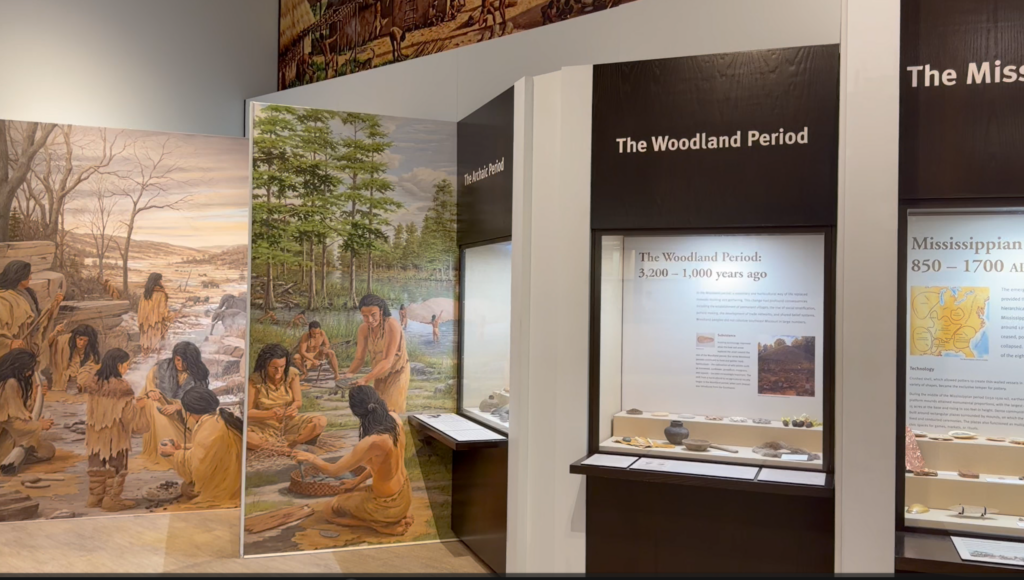
Across Cape Girardeau, Southeast Missouri State University’s Crisp Museum offers another way to explore Native American history through student-made replicas, artwork and educational displays.
The exhibits follow the development of Indigenous communities through the Paleo-Indian, Archaic, Woodland and Mississippian periods.
Displays illustrate changes in hunting methods, farming, pottery and housing over time.
Among the exhibits are replicas of early hunting tools, a Mississippian-era dwelling and a diorama showing the earthen mounds built by Indigenous communities in southeast Missouri.
The museum also features murals by artist Michael Rosato depicting early Native American life.
Ellen Flentge, curator of education at Crisp Museum, walked FOX23 through the displays, explaining how Native American communities adapted to their environments and developed new tools and ways of living.
Flentge became emotional while discussing the importance of remembering Indigenous history and passing traditions to future generations.
“We are very always thankful for our ancestors and in the future, for our future generations,” Flentge said.
She also emphasized the craftsmanship and cultural significance reflected in the objects represented throughout the displays.
“There is so much beauty in what is created by the Native Americans with all of their materials,” Flentge said. “The heart that goes into an object when you create it and passing it along or gifting it.”
Flentge said community and connection are also important themes in understanding Indigenous cultures.
“There’s an understanding of having a balance in your life. You’re going to have ups and downs, but you have your community that is going to help you,” she said.
The Crisp Museum is located at SEMO’s River Campus, 518 S. Fountain St. in Cape Girardeau. Admission is free.
More information about exhibits and visiting hours is available on the Crisp Museum website.